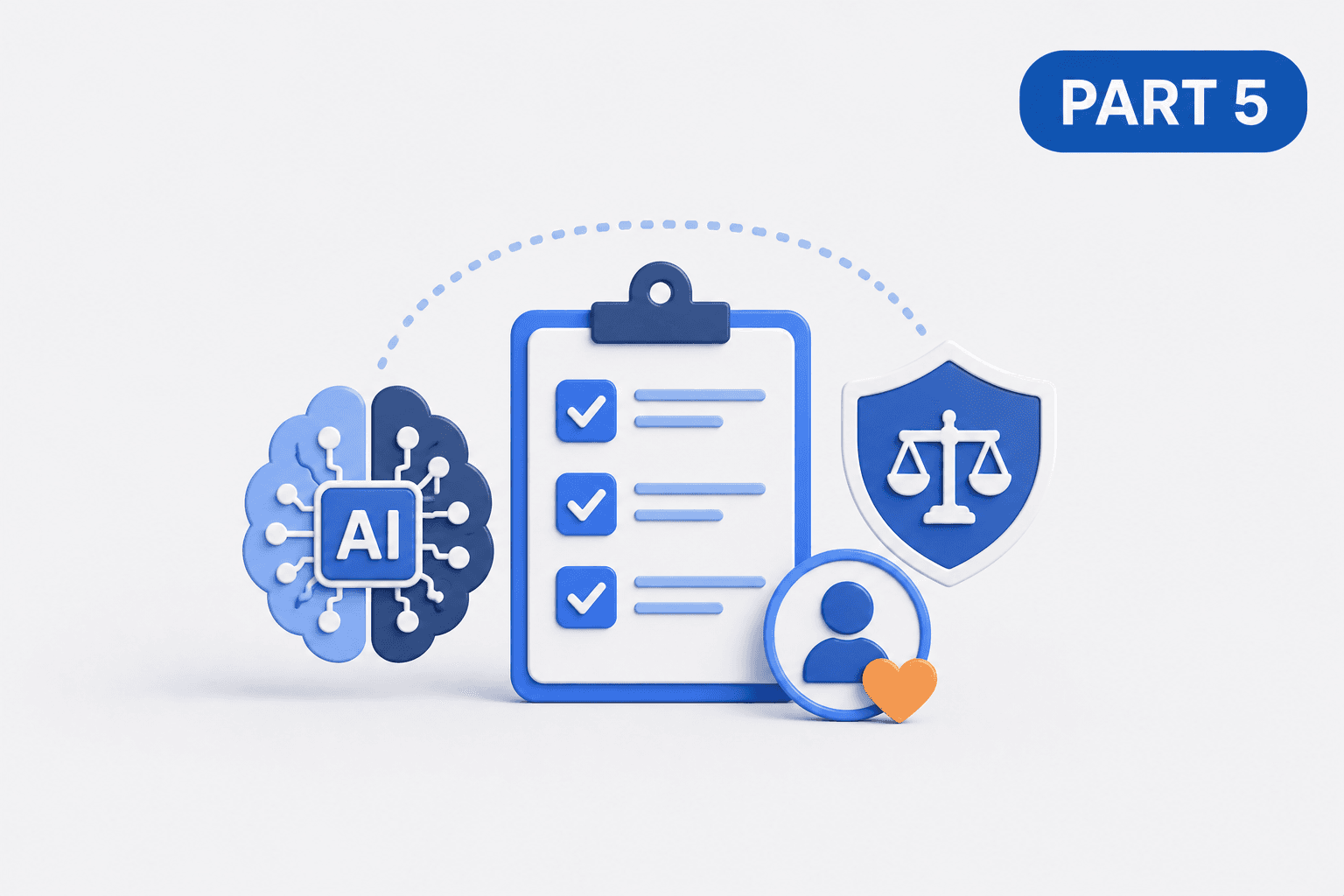
The Practical Payoff — and the Price of Getting It Wrong
Earlier in this series, we established that artificial intelligence is not here to replace the healthcare workforce — the hybrid model of humans plus machines is the realistic future. That leaves two vital questions, and they belong together:
- What exactly is AI doing for healthcare workers and patients?
- How do we make sure it earns trust instead of eroding it?
This concluding installment answers both. First, the practical payoff: how AI reduces the administrative burden that strains the American medical system. Then, the guardrails: the ethical framework that determines whether that efficiency builds trust or becomes another layer of corporate secrecy.
Part One: The Administrative Burden Problem
For decades, administrative load has grown steadily in American healthcare, pulling skilled professionals away from their primary duties and inflating organizational costs. The scale is staggering: administrative spending accounts for an estimated 15-25% of total U.S. healthcare expenditure, and physicians routinely report spending nearly two hours on paperwork for every hour of direct patient care.
The friction shows up everywhere:
- Clinical documentation that consumes evenings ("pajama time" charting)
- Prior authorization requests — 39-43 per physician per week by AMA estimates
- Claims coding, submission, edits, and resubmission cycles
- Eligibility verification and benefits checking, phone call by phone call
- Scheduling, intake forms, and referral coordination handled manually
Every hour spent on these tasks is an hour not spent with patients — and a cost ultimately embedded in the prices patients pay.
Where AI Actually Helps
AI offers a pragmatic way forward: automating high-volume, repetitive tasks to lighten the administrative load, cut structural overhead, and restore focus to patient care. This is not about removing human judgment — it is about using technology to let humans do what they do best.
Documentation and Clinical Notes
Ambient AI scribes draft visit notes from the clinician-patient conversation, cutting documentation time dramatically and returning attention to the patient in the room. The clinician reviews and signs — judgment stays human.
Coding and Claims
AI-assisted coding suggests procedure and diagnosis codes from documentation, flags mismatches before submission, and reduces the denial-and-rework cycle that delays payment and inflates cost.
Eligibility, Authorization, and Scheduling
Automated eligibility checks, prior-authorization form preparation, and intelligent scheduling remove hours of phone-tree labor per staff member per day.
Pricing Data Processing
This is where ExploreCarePricing lives: hospital machine-readable files are enormous, inconsistent, and humanly impossible to review line by line. Automation parses, organizes, and standardizes millions of published rates so consumers can actually use them. The efficiency gain serves transparency directly.
The Quality Safeguard
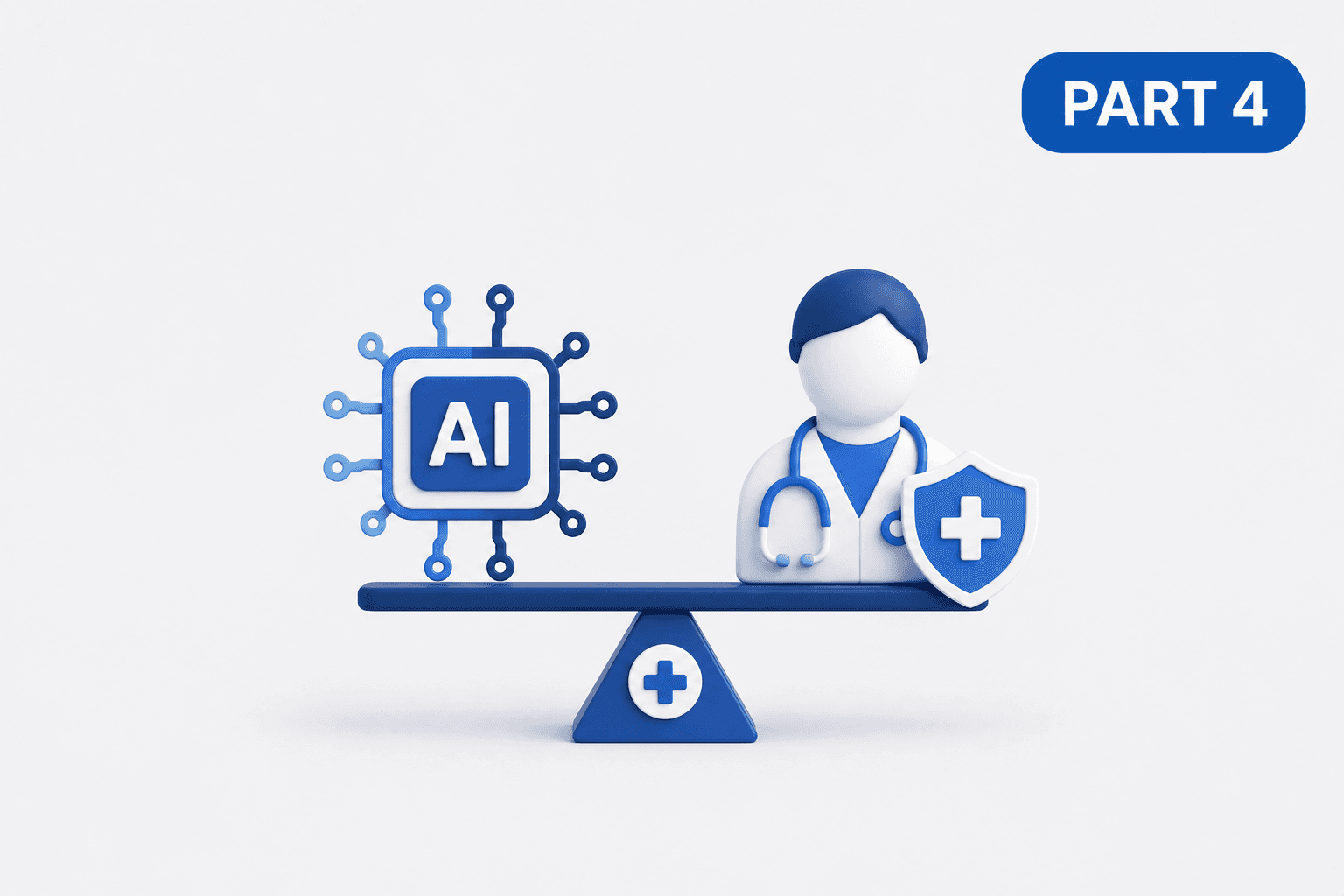
None of this compromises quality when one rule is respected: AI drafts, humans decide. Every automated output — a note, a code, a price interpretation — remains subject to human review, audit trails, and correction loops. Efficiency without verification is how errors scale; efficiency with verification is how burden falls while quality holds.
Part Two: The Trust Deficit — Why Ethics Cannot Be an Afterthought
If technology successfully solves the administrative and operational logjams in clinical environments and the revenue cycle, a deeper structural dilemma emerges: how do we ensure that automation does not compromise patient trust or violate data ethics?
The relationship between the American public and healthcare finance has long been defined by a profound trust deficit. Decades of hidden rates, unexpected out-of-network bills, and opaque insurer negotiations have left consumers rightfully suspicious of the system. Introducing complex, unconstrained AI models into this environment risks expanding that skepticism.
If an algorithm calculates a rate, flags a clinical workflow, or justifies a claim denial behind closed doors, it ceases to be an innovation — it becomes just another layer of corporate secrecy.
The Ethical Pivot: Deterministic Over Opaque
Ethical AI in healthcare demands a decisive pivot away from opaque, probabilistic predictive models toward verifiable, deterministic data structures. A price shown to a consumer should trace back to a published source — a hospital's machine-readable file, a payer's posted rate — not emerge from a black box that "predicts" what care might cost. In this paradigm, transparency is not a marketing slogan; it is the baseline for consumer advocacy and operational integrity.
Four Principles for Trustworthy Healthcare AI
- Transparency: users should know when AI is involved and where its outputs come from — sources cited, methodology published
- Accountability: a human organization remains answerable for every AI-assisted decision; "the algorithm did it" is never an acceptable answer, especially for claim denials
- Verifiability: outputs must be auditable against source data — deterministic pipelines over unexplainable predictions wherever decisions affect money or care
- Privacy and data ethics: administrative AI should minimize sensitive data exposure, honoring HIPAA not just in letter but in architecture
What This Means in Practice
- For patients: ask whether a denial or estimate was AI-generated, and request the human review you are entitled to
- For providers: choose vendors who publish methodology, provide audit trails, and keep clinicians in the loop
- For transparency tools: show your sources — ExploreCarePricing presents data traceable to hospitals' own published files, and we do not create, alter, or predict prices
Closing the Series: Efficiency and Ethics Are the Same Project
Across this series we have examined what AI can and cannot do for healthcare pricing: methodology over hype, hybrid human-machine models, real operational gains, and now the ethical foundation beneath it all. The conclusion is simple: reducing administrative burden and preserving trust are not competing goals. Done right, they are the same project — technology handles the repetitive volume, humans keep the judgment, and transparency proves it to everyone watching.
Key Takeaways
- Administrative work consumes an outsized share of U.S. healthcare spending and clinician time — and those costs flow into patient prices
- AI meaningfully reduces burden in documentation, coding, authorization, scheduling, and pricing-data processing
- Quality holds when AI drafts and humans decide — review, audit trails, and correction loops are non-negotiable
- Healthcare's trust deficit means opaque AI risks becoming another form of secrecy, especially in pricing and claim decisions
- Trustworthy healthcare AI is transparent, accountable, verifiable, and privacy-respecting — deterministic sources over black-box predictions
- Efficiency and ethics succeed together or fail together
Frequently Asked Questions (FAQ)
Q: Will AI replace healthcare administrative staff?
A: Roles will shift more than disappear. AI absorbs repetitive volume — data entry, form preparation, first-draft coding — while staff move toward exception handling, patient communication, and oversight.
Q: Does AI-assisted documentation compromise accuracy?
A: Not when properly implemented. Clinicians review and sign every AI-drafted note. Studies of ambient documentation show time savings with maintained accuracy when human review is enforced.
Q: Can an insurance company deny my claim using AI alone?
A: Regulators are increasingly clear that coverage denials require appropriate human clinical review. If you suspect an automated denial, appeal and explicitly request human review of the decision.
Q: How do I know if a price estimate came from real data or a prediction?
A: Ask for the source. Trustworthy tools cite hospital or payer published files. ExploreCarePricing presents data traceable to hospitals' own machine-readable files rather than generating predictions.
Q: Is my health data used to train these AI systems?
A: Practices vary — and that is exactly why data ethics matter. Ask vendors and providers whether identifiable data is used for training and what de-identification standards apply. HIPAA governs use and disclosure, but architecture choices matter beyond minimum compliance.
Q: What should healthcare organizations demand from AI vendors?
A: Published methodology, audit trails, human-in-the-loop controls, source citation for outputs, and clear accountability terms. If a vendor cannot explain how outputs are produced, that is the answer.
References & Further Reading
- American Medical Association. Prior authorization physician survey. https://www.ama-assn.org/
- Office of the National Coordinator for Health IT / HHS. Health IT and AI policy resources. https://www.healthit.gov/
- U.S. Department of Health & Human Services. HIPAA privacy and security rules. https://www.hhs.gov/hipaa
- Centers for Medicare & Medicaid Services. Hospital Price Transparency. https://www.cms.gov/priorities/key-initiatives/hospital-price-transparency

Important Disclaimer
This article is provided for general educational and informational purposes only and does not constitute medical, financial, legal, or insurance advice. AI capabilities, healthcare regulations, and organizational practices vary and evolve rapidly. Healthcare decisions should be made in consultation with qualified healthcare providers; organizations should consult compliance and legal counsel when implementing AI systems. For specific information about your coverage or healthcare situation, contact your healthcare provider or insurance company directly.