Healthcare has no shortage of explanations for why costs continue to rise.
Providers point to reimbursement pressure and increasing operating costs. Employers point to escalating premiums and benefit expenses. Patients point to affordability and unexpected bills. Payers point to utilization, risk, and the cost of delivering care.
The difficult question is not whether these concerns are real. The difficult question is whether anyone can see the complete financial path that created them.
Healthcare has a visibility problem. Not because information doesn't exist—it does, in abundance. But because each stakeholder in the system sees only their corner of a much larger financial landscape.
The Journey of a Healthcare Dollar
The healthcare dollar has a journey. It begins before care is delivered and continues long after the patient leaves the facility.
- Premiums are collected
- Benefits are designed
- Contracts are negotiated
- Claims are submitted
- Payments are calculated
- Bills are generated
Yet the story changes depending on who is reading it:
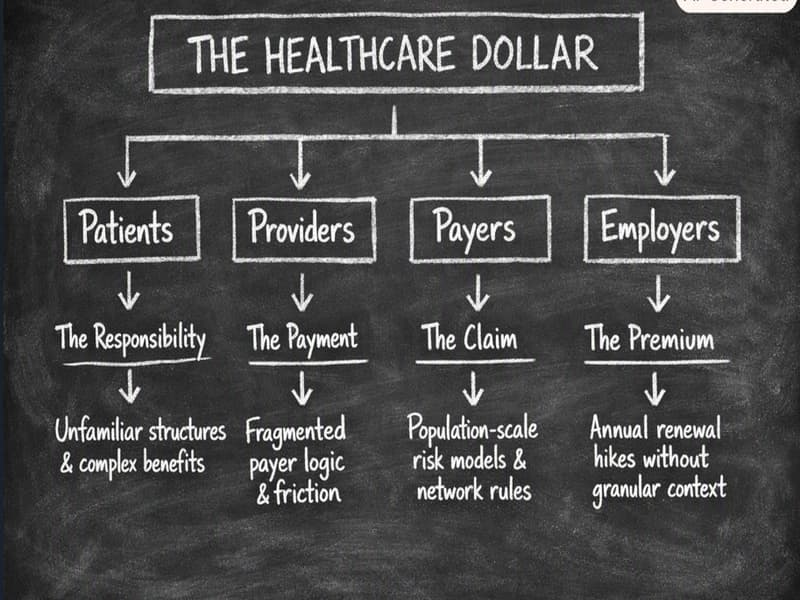
- The provider sees the payment
- The payer sees the claim
- The employer sees the premium
- The patient sees the responsibility
Each view is real. Each view contains important information. But each view represents only one part of the journey.
The Four Perspectives
When financial visibility is limited to a single vantage point, even the most well-intentioned strategies produce unintended friction. The healthcare system does not have a shortage of people trying to solve the problem—it has a challenge connecting the different perspectives required to understand it.
Patients — The Responsibility
For patients, the financial journey is experienced almost entirely at the end of care. They navigate unfamiliar pricing structures, complex benefit designs, and explanations of benefits (EOBs) that are difficult to translate into actionable financial decisions.
Research demonstrates that out-of-pocket costs and cost-sharing designs significantly influence patient behavior, often leading individuals to delay necessary care simply because predicting their final responsibility is so difficult (Brot-Goldberg et al., 2017). When patients cannot see the financial path ahead, they make decisions based on fear and uncertainty rather than full information.
Providers — The Payment
Providers operate in a high-volume environment where financial operations carry heavy administrative demands. Health policy research estimates that billing and insurance-related (BIR) administrative activities account for roughly 15% to 25% of overall administrative costs in physician practices and hospital systems (Tseng et al., 2018).
Revenue cycle teams know what they billed, what was paid, and whether a claim was denied—but they often lack full visibility into how complex payer reimbursement logic is applied across thousands of claims over time. This means providers operate reactively, responding to denials rather than understanding patterns that could improve front-end submission accuracy.
Payers — The Claim
Payers bear the massive responsibility of managing healthcare spending through risk models, network design, negotiated rates, and claims administration at population scale. Their systems are designed to balance affordability and financial risk across millions of members.
However, managing at population scale can make individual pricing decisions and reimbursement variations difficult for consumers and providers to anticipate or understand (Cooper et al., 2019). Payers often cannot easily communicate why specific rates exist or how their adjudication logic impacts downstream provider and patient decisions.
Employers — The Premium
As the primary funders of commercial healthcare in the United States, employers cover over 150 million Americans (Kaiser Family Foundation, 2023). Plan sponsors and HR leaders are tasked with balancing employee benefits against company sustainability.
Under evolving fiduciary expectations, employers are increasingly expected to ensure plan assets are used prudently (Consolidated Appropriations Act, 2021). Yet they are often forced to make multi-million-dollar decisions based on annual renewal increases rather than detailed visibility into the underlying utilization, pricing, and reimbursement dynamics driving those hikes.
The Cost of Fragmented Visibility
In recent years, federal regulatory efforts—such as the Hospital Price Transparency Rule and the Transparency in Coverage (TiC) regulations—have made vast amounts of pricing data public, including machine-readable files (MRFs) (Centers for Medicare & Medicaid Services, 2020).
However, data availability has highlighted a fundamental truth: pricing in healthcare is not a single static number. It exists in interconnected layers:
- Billed Charge: The initial listed rate prior to adjustments
- Negotiated Rate: The contractual agreement between payer and provider
- Allowed Amount: The dynamic payment ceiling set for a covered service
- Patient Responsibility: The portion dictated by plan design (copay, coinsurance, deductible)
- Reimbursement Methodology: The underlying logic (fee-for-service, capitation, bundled, value-based)
- Quality & Utilization: The contextual clinical dynamics driving the encounter
A price without this context is just another disconnected data point.
True transparency is not simply revealing numbers. It is creating understanding.
When stakeholders only see isolated fragments, information asymmetry fuels administrative appeals, friction, and systemic inefficiency. The solution is not dumping more raw data onto the market, but creating shared context around how these layers interact.
The Missing Layer: Intelligence Infrastructure
Healthcare does not need more data. It needs more intelligence.
An enormous amount of raw data already exists across the ecosystem:
- Machine-readable files (MRFs)
- Claims clearinghouse datasets
- Fee schedules and provider contracts
- Explanation of Benefits (EOBs)
- Utilization and quality metrics
The challenge is no longer data access; it is data synthesis. The future of healthcare will not be built by giving each stakeholder more information in isolation. It will require connecting the information that already exists to create a clearer, multi-perspective picture of how healthcare dollars move.
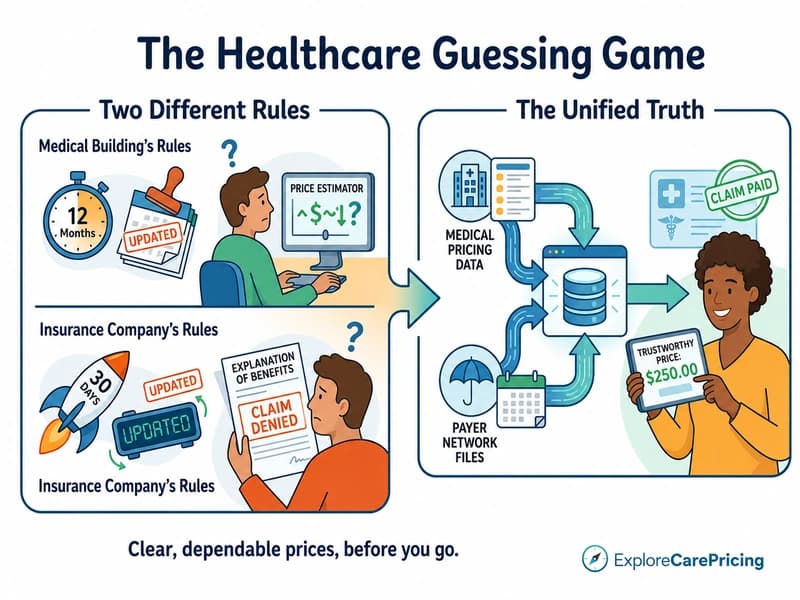
This requires a shift toward dedicated intelligence infrastructure. Rather than adding another standalone cost estimator or raw data file to the mix, the ecosystem needs tools that function as an intelligence layer—connecting provider reimbursement patterns, payer contract dynamics, and real consumer costs into a single, cohesive view.
Why This Matters
When each stakeholder operates from their isolated vantage point:
- Providers struggle with denial patterns they don't fully understand
- Payers struggle to communicate pricing logic to providers and patients
- Employers make benefit decisions based on incomplete information
- Patients delay necessary care due to cost uncertainty
The cumulative result is waste, inefficiency, and eroded trust.
When providers understand reimbursement behavior, employers understand cost drivers, payers achieve sustainable alignment, and consumers understand financial expectations, the system naturally moves from confusion toward shared accountability.
Frequently Asked Questions (FAQ)
Q: Why can't each stakeholder just see the entire healthcare dollar journey themselves?
A: Because the data lives in separate systems owned by different organizations. Providers don't have direct access to what insurers pay or what patients owe. Patients don't see payer adjudication logic. Employers don't see provider-level utilization patterns. Each system is optimized for that organization's needs, not for providing cross-system visibility.
Q: Doesn't federal price transparency solve this problem?
A: Transparency data (MRFs and TiC files) reveals the numbers, but not the context. A consumer sees that MRIs cost $450 to $2,100 in their area, but doesn't understand why or how their specific plan fits into that range. Transparency is necessary but not sufficient without intelligence infrastructure that explains the "why."
Q: How does fragmented visibility affect healthcare costs?
A: Lack of visibility creates inefficiency at every stage: providers submit claims incorrectly because they don't understand payer logic, triggering denials and appeals; payers must process denials manually; employers can't identify cost-driving patterns because they lack utilization data; patients delay or forgo care due to cost uncertainty. These inefficiencies compound across the system.
Q: Can AI or better data tools solve this?
A: Yes, but only if those tools function as intelligence infrastructure that connects multiple data sources and creates shared understanding. Simply dumping more data or AI predictions onto isolated stakeholders won't solve the problem. What's needed are tools that translate data across organizational boundaries and create mutual understanding.
Q: What would better visibility actually change?
A: Providers could reduce claim denials by understanding payer logic upfront. Payers could communicate more effectively with providers and patients. Employers could make smarter benefit design decisions based on real cost drivers. Patients could make healthcare decisions with full financial information rather than uncertainty.
Q: Who should be responsible for building this intelligence infrastructure?
A: This requires collaboration. Payers, providers, employers, and technology platforms all have roles to play. No single organization can do it alone, but platforms like ExploreCarePricing that analyze publicly available data can help connect the dots for stakeholders who lack direct visibility into other parts of the system.
Key Takeaway
By following the dollar together, we can move past individual blind spots—and start making decisions that serve the entire ecosystem.
Important Disclaimer
This article is provided for general educational and informational purposes only and should not be considered medical, legal, financial, or insurance advice. Healthcare systems, reimbursement methodologies, benefit designs, and organizational practices vary significantly by employer, payer, provider, state, and individual circumstances.
The observations presented reflect industry trends and research at the time of publication. Healthcare policy and practice continue to evolve. Before making decisions about healthcare benefits, coverage, or costs, consult with qualified professionals including your healthcare provider, benefits administrator, insurance representative, or financial advisor.
References
- Brot-Goldberg, Z. C., Chandra, A., Handel, B. R., & Kolstad, J. T. (2017). What does a deductible do? The impact of cost-sharing on health care prices, quantities, and spending dynamics. The Quarterly Journal of Economics, 132(3), 1261–1318. https://doi.org/10.1093/qje/qjx013
- Tseng, P., Kaplan, R. S., Richman, B. D., Shah, M. A., & Schulman, K. A. (2018). Administrative costs associated with physician billing and insurance-related activities at an academic health care system. JAMA, 319(7), 691–697. https://doi.org/10.1001/jama.2017.19141
- Cooper, Z., Craig, S. V., Gaynor, M., & Van Reenen, J. (2019). The price ain't right? Hospital prices and health spending on the privately insured. The Quarterly Journal of Economics, 134(1), 51–107. https://doi.org/10.1093/qje/qjy020
- Kaiser Family Foundation. (2023, October 18). 2023 Employer health benefits survey. https://www.kff.org/report-section/ehbs-2023-summary-of-findings/
- Consolidated Appropriations Act, 2021, Pub. L. No. 116-260, § 201, 134 Stat. 1182 (2020)
- Centers for Medicare & Medicaid Services. (2020). Transparency in coverage final rule (85 FR 72158) & hospital price transparency requirements (45 CFR Part 180). U.S. Department of Health and Human Services. https://www.cms.gov/hospital-price-transparency