Imagine Buying Groceries the Way We Buy Healthcare
Imagine going to a grocery store, picking up a box of cereal, and asking the cashier how much it costs.
Now imagine the cashier looked at you and said: "Well, it might be $4.00, or it might be $10.00. We will not know the real price until two months after you take it home and eat it."
You would probably walk out of the store. But sadly, this is exactly how buying healthcare works every single day in the United States.
A knee MRI might cost $450 in Los Angeles, $1,200 in Denver, and $2,100 in rural South Dakota. A routine blood test could be $18 at one facility and $140 at another just 20 miles away. Consumers see these massive price discrepancies every day, but few understand the underlying forces driving them.
The Myth of "Standard Pricing"
Most consumers assume that medical procedures have standard list prices, similar to retail items. In reality, healthcare pricing in the United States is not standardized, nor is it regulated like retail goods or public utilities. It is not a simple reflection of the clinical cost of delivering care.
Instead, every price is the product of a highly complex web of insurer negotiations, geographic market concentration, institutional cost structures, and state-level policy environments. Pricing is entirely contract-based, negotiated, and highly variable — even for the exact same service within the very same hospital walls.
A landmark study published in The Quarterly Journal of Economics by Cooper, Craig, Gaynor, and Van Reenen (2019) analyzed millions of commercial insurance claims to map this variation. Their research revealed three critical truths:
- Prices for identical procedures vary widely across different geographic regions of the United States
- Prices vary dramatically across competing hospitals within the same local market
- Prices vary significantly within the exact same hospital depending on which insurer is paying
What Actually Drives Coast-to-Coast (and County-to-County) Price Differences
1. Market Competition — or the Lack of It
In metropolitan areas with several competing hospital systems, insurers have leverage to negotiate lower rates. In rural or consolidated markets where one health system dominates, that leverage disappears. This is why the same procedure can cost three to four times more in a rural market than in a competitive metro market.
2. Economies of Scale
High-volume facilities spread their fixed costs — buildings, equipment, staffing — across thousands of procedures. Low-volume facilities must recover those same fixed costs across far fewer patients, pushing per-procedure prices upward.
3. State Policy Environments
States differ in Medicaid payment policies, insurance regulations, certificate-of-need laws, and charity care requirements. These policy differences ripple directly into the commercial prices hospitals negotiate with insurers.
4. Payer Mix and Payer Logic
A negotiated rate is what a hospital hopes to be paid; payer logic determines what it actually collects. Hospitals serving large Medicare and Medicaid populations often shift costs to commercial insurance contracts, raising prices for privately insured patients in those regions.
The Blind Handoff: Why You Learn the Price After the Care
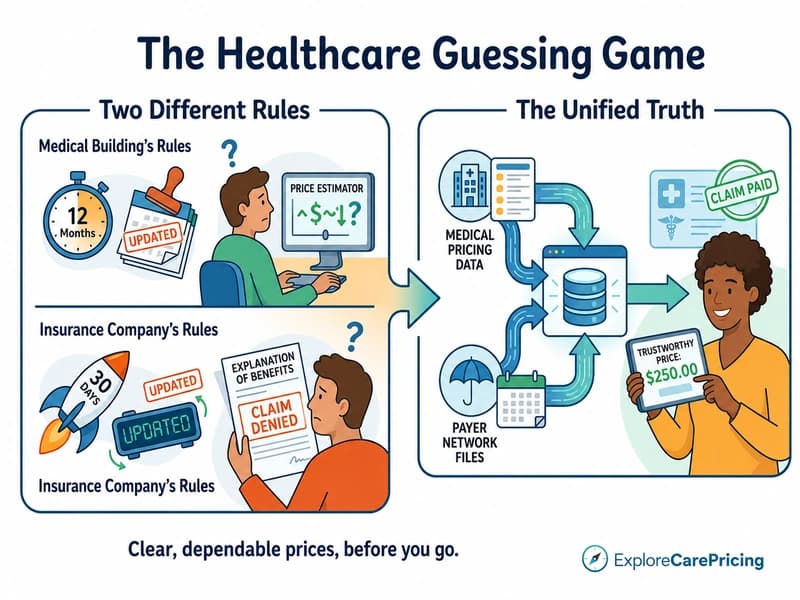
There is a hidden moment in healthcare that quietly drains both patient wallets and provider revenue across the country — what we call the Blind Handoff.
Care is delivered today, but the financial consequences are not discovered until weeks or months later, after insurance adjudication, claim edits, and denials have run their course. The patient hands off their insurance card, the provider hands off a claim, and both sides wait in the dark for the final number.
And depending on where you live, the impact can be enormous. Claim denial rates vary dramatically from state to state. In some states, denial burdens are so high that preventable losses have become a structural reality for providers — and surprise balances have become a recurring reality for patients.
Two Sides, Two Different Playbooks
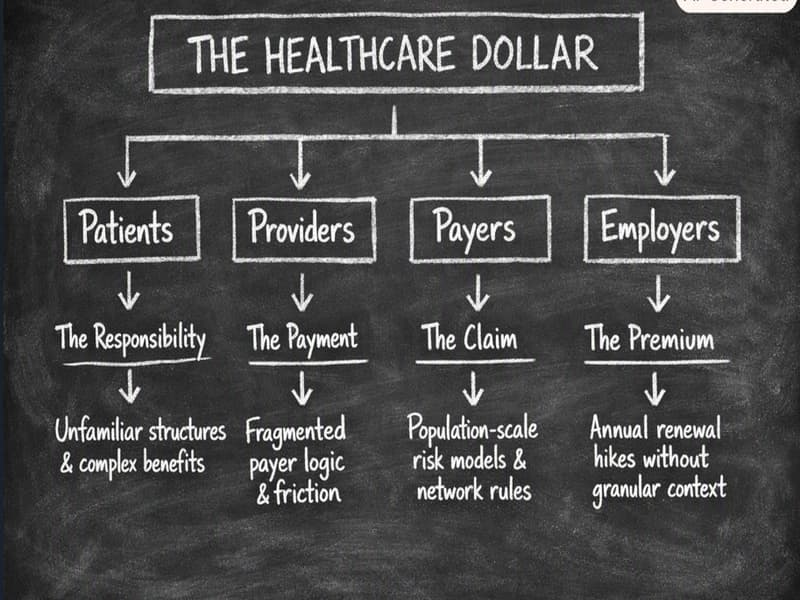
Part of the reason the guessing game persists is information asymmetry. Hospitals and insurers each operate from sophisticated pricing playbooks — chargemasters, negotiated rate sheets, adjudication rules — while patients operate with almost no information at all.
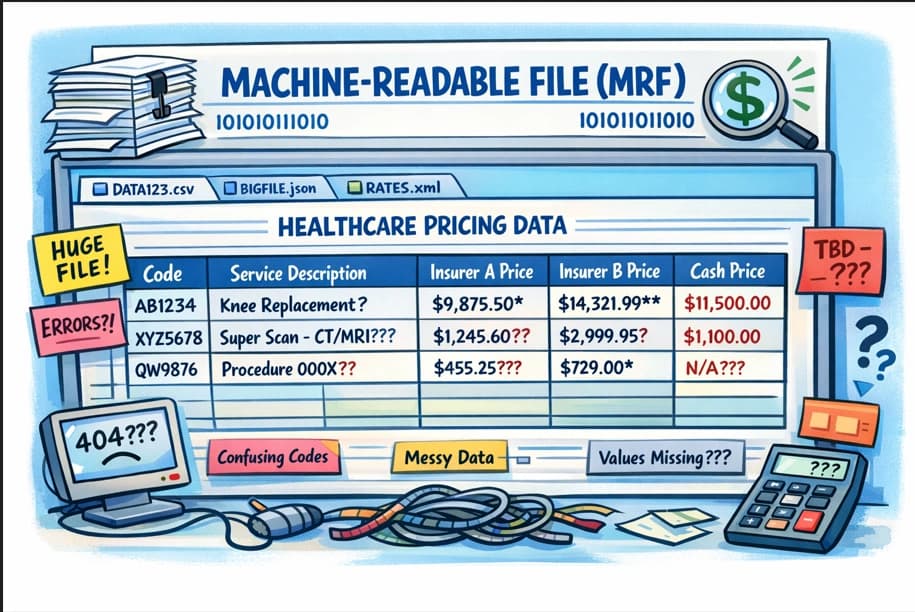
Federal transparency regulations were designed to close this gap. Since 2021, hospitals must publish standard charges, cash prices, and insurer-negotiated rates in machine-readable files. Since 2022, insurers must publish their negotiated rates as well. The rules exist — but implementation has been inconsistent, files are often difficult for ordinary consumers to use, and awareness remains low.
How to Stop Guessing: Practical Steps for Patients
- Look up prices before you schedule. Use hospital price transparency pages or a comparison tool like ExploreCarePricing to see cash prices and negotiated rates for your procedure in your area.
- Compare across facilities — even nearby ones. Because prices vary county to county, checking two or three facilities within driving distance can save hundreds or thousands of dollars.
- Ask for the cash price and the negotiated rate. Sometimes the cash price is lower than your insurance rate, especially before you have met your deductible.
- Request a written estimate before non-emergency care. Under the No Surprises Act, you have the right to a Good Faith Estimate.
- Wait for the final bill, then verify it. Because of the Blind Handoff, first bills often change. Compare the final bill against the estimate and the published transparency data before paying.
How ExploreCarePricing Levels the Playing Field
ExploreCarePricing was built to end the guessing game. We analyze and organize the pricing data hospitals are required to publish, then present it in a format ordinary consumers can actually use — side-by-side comparisons of cash prices, negotiated rates, and regional benchmarks.
Instead of discovering the price two months after care, you can see what facilities in your area typically charge before you ever schedule an appointment.
Key Takeaways
- Healthcare pricing is shaped by geographic competition, economies of scale, state policy, and payer logic — not by standardized costs
- The same procedure can cost 3-4x more in a rural market than in a competitive metropolitan market
- Where you live affects not only your price, but how predictable that price is — denial rates and billing outcomes vary by state
- A negotiated rate is what hospitals hope to be paid; payer logic determines what they actually collect
- Federal transparency regulations now expose these variations, giving consumers unprecedented access to pricing data
- Comparing prices before care — even across nearby counties — is one of the most effective ways to lower your healthcare costs
Frequently Asked Questions
Q: Why does the same MRI cost so much more in one city than another?
A: Local market competition, facility cost structures, state policies, and insurer negotiating leverage all differ by region. In markets with little competition, hospitals can command far higher negotiated rates.
Q: Is the hospital list price what I will actually pay?
A: Almost never. List (chargemaster) prices are starting points for negotiation. Your actual cost depends on your insurance plan, network status, deductible progress, and whether you pay cash.
Q: Why does my final bill differ from the first bill I received?
A: Claims often go through multiple rounds of adjudication, edits, and corrections — the Blind Handoff effect. Hospitals themselves frequently advise patients to wait for the final bill.
Q: Can I really shop for healthcare like other services?
A: For shoppable, non-emergency services — imaging, labs, planned procedures — yes. Transparency data now makes meaningful comparison possible, especially with consumer tools that organize it.
Q: Does driving to the next county ever actually save money?
A: Frequently, yes. Because prices vary at the county and facility level, a short drive can mean substantial savings on imaging, labs, and outpatient procedures.
Q: Where does ExploreCarePricing get its data?
A: From the machine-readable files hospitals and insurers are federally required to publish. We organize and present that public data; we do not create or alter it.
References & Further Reading
- Cooper, Z., Craig, S., Gaynor, M., & Van Reenen, J. (2019). The Price Ain't Right? Hospital Prices and Health Spending on the Privately Insured. The Quarterly Journal of Economics.
- Centers for Medicare & Medicaid Services (2021). Hospital Price Transparency Final Rule. https://www.cms.gov/priorities/key-initiatives/hospital-price-transparency
- Centers for Medicare & Medicaid Services (2022). Transparency in Coverage Final Rule.
- Centers for Medicare & Medicaid Services. No Surprises Act consumer resources. https://www.cms.gov/nosurprises


Disclaimer
This article is provided for general educational and informational purposes only and should not be considered medical, legal, financial, or insurance advice. Healthcare laws, regulations, insurance benefits, reimbursement methodologies, and pricing practices may change over time and vary by state, health plan, provider, employer, and individual circumstances. Before making healthcare or financial decisions, consult with your healthcare provider, health insurance company, employer-sponsored health plan administrator, or other qualified professionals.