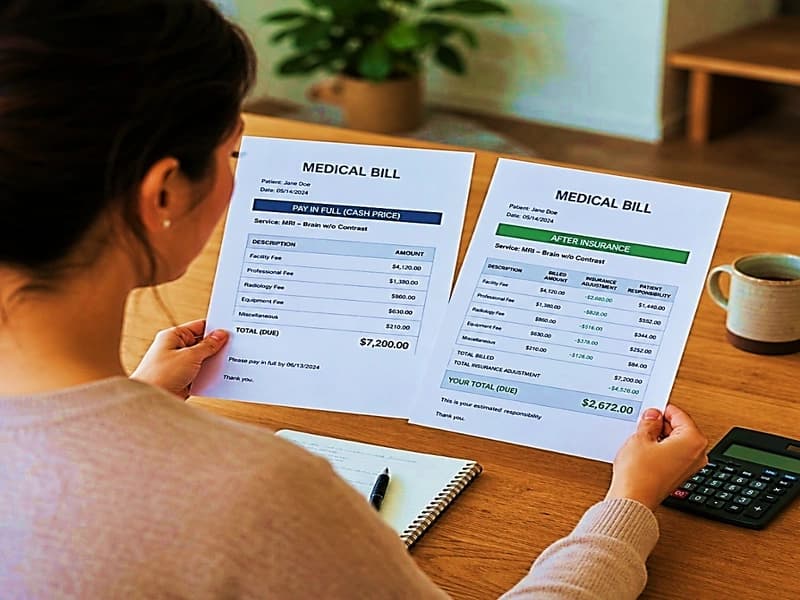
You Already Handed Over Your Insurance Card. Can You Still Pay Cash?
Healthcare consumers face a decision that almost nobody understands: when you have insurance, can you still choose to pay cash for a service instead? The answer is: it is complicated.
In theory, patients should have the freedom to select the payment method they prefer. In practice, healthcare billing rules, insurance contracts, and regulatory requirements create significant friction around "self-pay" options for people who have active insurance coverage.
And for the millions of Americans covered by high-deductible health plans (HDHPs), the question is even sharper. You already know the frustration: you have insurance, but your out-of-pocket costs feel like you do not. The average HDHP deductible for individual coverage in 2026 is $1,735 — and $3,469 for family coverage. That is a substantial amount you pay before insurance coverage meaningfully kicks in.
This guide covers the whole decision: your payment options, when each makes sense, the hidden barriers, the deductible trap, and a step-by-step framework — with a dedicated playbook for HDHP enrollees.
Understanding Your Two Payment Pathways
When you arrive for a healthcare service with active insurance, you have two theoretical payment pathways:
- Use Insurance: submit the claim to your health plan and pay your portion (copay, coinsurance, or deductible)
- Pay Cash: decline to use insurance and pay the provider directly out-of-pocket
Each pathway has financial, legal, and operational implications that most patients never anticipate.
When to Use Insurance
Insurance is designed to protect you from catastrophic costs. You should generally use insurance when:
- Your deductible is already met, or you have paid substantially toward it
- You are facing a major procedure or hospitalization ($5,000-$10,000+)
- You have a chronic condition requiring ongoing specialist care
- Multiple family members will need healthcare in the same year
- The service is preventive care — covered at 100% under the ACA with no deductible
- The procedure requires prior authorization or medical necessity review
When Paying Cash Might Work
The cash-pay option becomes attractive in specific scenarios:
- Your deductible is extremely high ($3,000-$5,000+) and far from met
- An independent facility offers a dramatically lower cash price than your negotiated in-network rate
- You have a high coinsurance rate (e.g., 30% after deductible) for the specific service
- A single cash-pay price is lower than your remaining deductible plus coinsurance exposure
- The service is elective or non-emergency, giving you time to comparison shop
The Hidden Complexity: Why Paying Cash Is Harder Than It Sounds
Even when patients request to pay cash, healthcare providers face regulatory and contractual barriers:
- In-Network Contracts: providers who have negotiated contracts with your insurer are generally bound to bill insurance for insured patients — many cannot accept cash-pay from you
- Federal Rules: the Transparency in Coverage Rule and Hospital Price Transparency Rule require specific pricing disclosures that apply differently to insured vs. cash-pay patients
- Billing System Barriers: most hospital billing systems are optimized for insurance claims; cash-pay requires different coding and processing
- Provider Policy: some providers prohibit self-pay for insured patients to avoid perceived network violations
Practical takeaway: cash-pay opportunities usually live at independent, out-of-network facilities — imaging centers, labs, and direct-pay clinics — not at the in-network hospital across the street.
The HDHP Playbook
The HDHP Paradox
HDHPs create a unique financial dynamic: your premiums are lower than traditional plans, but your out-of-pocket costs are higher until you meet your deductible — and you are personally responsible for paying most care costs upfront. This structure is appealing for healthy people who rarely use healthcare, but punishing for those with chronic conditions or unexpected medical events. For HDHP enrollees, the insurance card in your wallet can feel almost useless until you have paid thousands out-of-pocket.
The HDHP Silver Lining: Your HSA
HDHP enrollees typically qualify for a Health Savings Account (HSA) — pre-tax dollars for medical costs that effectively discount every bill by your tax rate. Important: your HSA eligibility depends on maintaining HDHP coverage, not on whether you pay cash or use insurance for specific services. You can use HSA funds for qualified expenses either way.
The Deductible Trap (Read This Twice)
This is critical: if you pay cash for a service, that payment does NOT count toward your deductible.
Example: you have a $3,000 deductible. You pay $800 cash for a procedure to avoid using insurance. Your deductible progress is unchanged — you still owe the full remaining deductible before insurance coverage kicks in on future claims.
This means paying cash only makes sense when the cash price is meaningfully lower than your insurance-route cost, AND you are unlikely to hit your deductible this year anyway. If you expect significant care later in the year, "wasting" payments outside your deductible can cost you more overall.
The Four-Step Decision Framework
- Know your deductible status. Call your insurer or check your portal: "How much of my deductible have I met?" and "What is my coinsurance percentage?"
- Get both prices. Ask the provider for (a) the negotiated insurance rate and (b) the cash-pay price. Many providers offer 20-40% cash discounts.
- Calculate your personal cost. Insurance route: remaining deductible portion + coinsurance on the balance. Cash route: the cash price. Compare directly.
- Consider the long-term. Factor in deductible progress: if you will likely need more care this year, payments through insurance build toward coverage; cash payments do not.
Real-World Scenarios
Scenario 1: Elective MRI with a High Deductible
Your plan's negotiated MRI rate is $1,200 and your deductible has $2,000 remaining — meaning you would pay the full $1,200 yourself through insurance. An independent imaging center offers $450 cash. Cash saves $750 today. The trade-off: no deductible progress. For a generally healthy person, cash wins clearly. For someone expecting surgery later this year, the math may flip.
Scenario 2: Urgent Care Visit
Deductible $3,000 with $200 paid. The visit costs $150 cash or $200 through insurance. Cash saves $50 — but the $200 insurance route builds deductible progress. Low stakes either way; choose based on whether you expect to reach your deductible.
Scenario 3: Preventive Care
Screenings, immunizations, and annual wellness visits are covered at 100% in-network under the ACA — no deductible applies, even on an HDHP. Paying cash for covered preventive care almost never makes sense.
Scenario 4: Non-Covered Elective Services
Cosmetic and other non-covered procedures are cash-pay by definition — this is where transparent flat pricing is most common, and comparison shopping delivers the biggest savings.
Key Takeaways
- You can request cash-pay, but in-network providers are generally bound to bill your insurance — real cash opportunities live at independent facilities
- Cash payments never count toward your deductible or out-of-pocket maximum
- Cash wins when the cash price beats your insurance-route cost AND you are unlikely to hit your deductible anyway
- HDHP enrollees face this decision most often — use the four-step framework and your HSA to soften the blow
- Preventive care is free in-network regardless of deductible; never pay cash for it
- For major procedures and chronic care, insurance remains the protective choice
Frequently Asked Questions
Q: Can a provider refuse my request to pay cash?
A: Yes. In-network providers are contractually obligated to bill insurance for insured patients. To pay cash, you typically need an independent or out-of-network provider.
Q: Does paying cash hurt my insurance or future claims?
A: No. Paying cash for one service does not affect future claims or premiums. It simply does not count toward your deductible or out-of-pocket maximum.
Q: Does paying cash with an HDHP cost less than using insurance?
A: Not always. Before your deductible is met, cash can be cheaper for routine care — especially at independent facilities. For major procedures, using insurance is typically better.
Q: Will paying cash affect my HSA eligibility?
A: No. HSA eligibility depends on maintaining HDHP coverage, not on how you pay for individual services. You can use HSA funds for qualified expenses whether you pay cash or use insurance.
Q: What if my deductible is already met?
A: Use insurance. Your coinsurance (typically 10-30%) will almost always beat cash rates once the deductible is satisfied.
Q: How do I find real cash prices to compare?
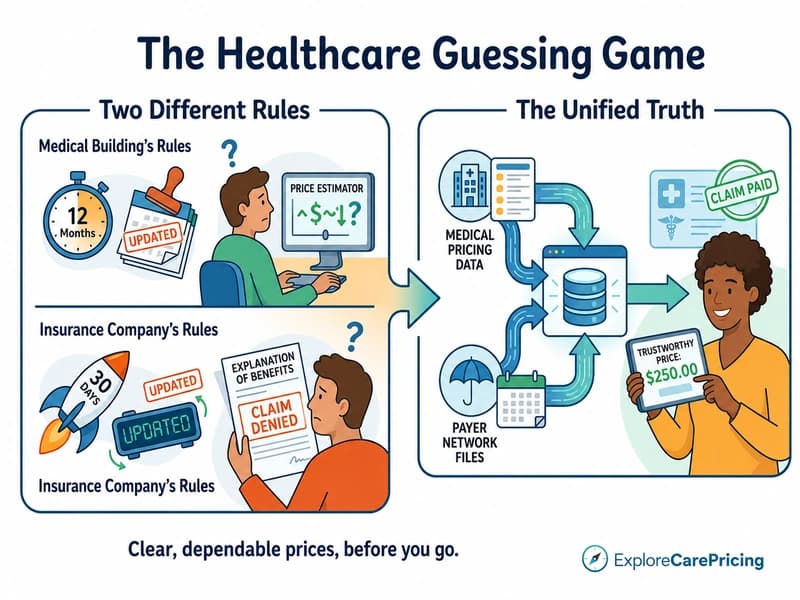
A: Hospitals must publish cash prices under federal transparency rules, and independent facilities often post flat rates. Tools like ExploreCarePricing organize this data for side-by-side comparison before you schedule.
References & Further Reading
- Centers for Medicare & Medicaid Services. Hospital Price Transparency. https://www.cms.gov/priorities/key-initiatives/hospital-price-transparency
- Centers for Medicare & Medicaid Services. Transparency in Coverage Rule. https://www.cms.gov/healthplan-price-transparency
- HealthCare.gov. Preventive care benefits. https://www.healthcare.gov/coverage/preventive-care-benefits/
- Internal Revenue Service. Publication 969: Health Savings Accounts. https://www.irs.gov/


Disclaimer
This article is provided for general educational and informational purposes only and should not be considered medical, legal, financial, or insurance advice. Insurance coverage, deductibles, coinsurance rates, HDHP and HSA rules, and pricing vary by plan, employer, provider, and individual circumstances, and may change over time. Always verify your specific coverage details with your insurance company and confirm prices directly with providers before making healthcare or financial decisions.