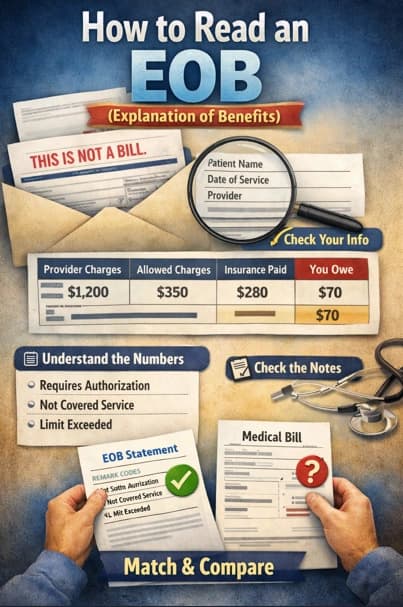
"THIS IS NOT A BILL." (So Why Does It Say I Owe $900?)
Few things spike your blood pressure like opening an envelope from your health insurance company. You pull out a multi-page document filled with tiny text, long numbers, and confusing charts. Then your eyes land on a dollar figure next to the words "patient responsibility" — and your stomach drops.
But look at the top of the page. In bold letters, you will almost always see: "THIS IS NOT A BILL."
This document is an Explanation of Benefits (EOB). It is not a request for payment. It is a report card showing how your insurance company processed a recent medical visit — what the provider charged, what your plan agreed to pay, and what portion may eventually land on your plate.
Understanding this one document is arguably the single most useful financial-literacy skill in American healthcare. It is how you catch billing errors before you pay them, how you verify your deductible is being tracked correctly, and how you know whether the bill that arrives later is even accurate. Let's decode it together, line by line.
EOB vs. Bill: The Difference That Confuses Everyone
Here is the mental model that makes everything click. After a medical visit, two documents are heading your way from two different senders:
- The EOB comes from your insurance company. It explains how the claim was processed. You never pay an EOB.
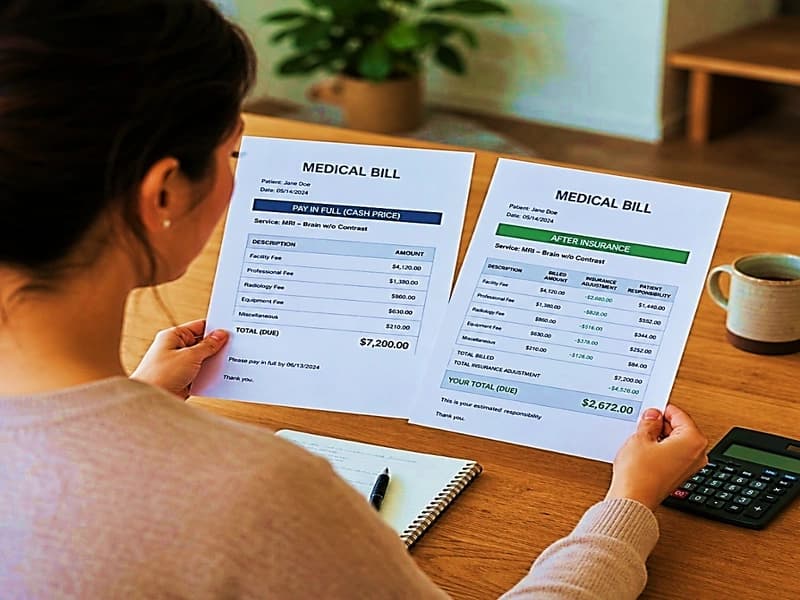
- The bill comes from your doctor or hospital. It requests actual payment — and it should match what the EOB said you owe.
The golden rule: never pay a medical bill until you have compared it against the matching EOB. If the bill asks for more than the EOB's "patient responsibility" amount, something is wrong — a billing error, a claim still being processed, or a charge that should have been submitted to insurance and wasn't. That five-minute comparison is where consumers catch most billing mistakes.
The Anatomy of an EOB: Every Section, Explained
Formats vary by insurer, but virtually every EOB contains the same building blocks. Here is your field-by-field tour:
1. The Header: Who, When, and What Claim
- Patient name and member ID — confirm it is actually you (family plans generate EOBs for every member)
- Provider name — who delivered and billed the care
- Date of service — when the visit happened (not when the claim processed)
- Claim number — your reference code for any phone call or appeal; keep it handy
2. The Money Columns: The Heart of the Document
This table is where the real story lives. Reading left to right, you will typically see:
- Amount Billed (or Provider Charges): the provider's full sticker price. Almost nobody actually pays this number.
- Allowed Amount (or Negotiated Rate): the discounted price your insurer contracted for. This is the "real" price of the service for you.
- Plan Discount (or Network Savings): the difference between billed and allowed — the amount that simply vanishes because of your network contract.
- Plan Paid: what your insurance actually paid the provider.
- Patient Responsibility (or What You Owe): the remainder that may be billed to you — made up of your deductible, copay, and/or coinsurance.
A quick example makes it concrete. Say an MRI shows: Billed $1,800 → Allowed $600 → Plan Paid $360 → Patient Responsibility $240. Translation: the hospital asked for $1,800, your insurer's contract cut it to $600, insurance covered 60% of that, and your 40% coinsurance share is $240. The $1,200 difference? Nobody pays it — it evaporates in the network discount. When the hospital's bill arrives, it should ask you for exactly $240. Not $1,800. Not $600.
3. The Cost-Sharing Breakdown: Deductible, Copay, Coinsurance
Your "patient responsibility" is usually itemized into three buckets — and knowing which bucket matters:
- Deductible: the amount you pay before insurance starts sharing costs. EOBs typically show how much of this charge applied to your deductible and your year-to-date progress. Watch this number — it is how you verify you are not being charged deductible amounts twice.
- Copay: the flat fee for the visit type ($25 primary care, $50 specialist, etc.), usually collected at check-in.
- Coinsurance: your percentage share (often 20-40%) of the allowed amount after your deductible is met.
4. Remark Codes: The Fine Print That Explains Everything
Near the bottom, you will find cryptic codes — CO-45, PR-1, OA-23 — with a legend explaining each. These "claim adjustment reason codes" tell you exactly why each dollar moved. A few worth recognizing:
- CO-45: charge exceeded the contracted rate — the routine network discount, nothing to worry about
- PR-1: applied to your deductible ("PR" means patient responsibility)
- PR-2 / PR-3: coinsurance / copay amounts
- CO-97: service bundled into another procedure's payment — you should not be billed separately for it
- Denial codes (often with "denied" language): the claim or a line item was not covered — this is your cue to investigate, not to automatically pay
If a code's explanation does not make sense, call the number on the EOB and ask. "Can you explain remark code X on claim number Y?" is a completely normal question that insurers answer all day long.
The Five-Minute Error Check (Do This With Every EOB)
Studies repeatedly find that a large share of medical bills contain errors. Your EOB is the error-detection tool. Run this checklist each time one arrives:
- Right patient, right provider, right date? Wrong-date or wrong-member claims happen more than you would think, especially on family plans.
- Do you recognize every service listed? If the EOB shows a test or procedure you never received, flag it — that is either an error or, occasionally, a sign of medical identity theft.
- Duplicates? The same service appearing twice on one date is a classic billing error.
- Does the math work? Allowed amount minus plan paid should equal your responsibility. If numbers do not reconcile, call.
- Deductible tracking correct? Compare the year-to-date deductible on this EOB with the previous one. If you have already met your deductible but charges are still being applied to it, that is money out of your pocket erroneously.
- When the provider's bill arrives: does it match the EOB's patient responsibility exactly? If the bill is higher, do not pay the difference until it is explained.
When the EOB Says "Denied": Your Appeal Playbook
A denial on an EOB is not the end of the story — it is the beginning of a process. Many denials are overturned on appeal, often because the original claim was missing documentation, used an imprecise code, or was processed against the wrong rule.
- Read the denial reason code first. "Not medically necessary," "out of network," "prior authorization missing," and "duplicate claim" each have different fixes.
- Call your insurer with the claim number. Ask exactly what would be needed to reprocess the claim. Sometimes the provider simply needs to resubmit with a corrected code.
- Loop in your provider's billing office. They appeal denials constantly and can submit clinical notes supporting medical necessity.
- File a formal appeal in writing if the phone route fails. Your EOB or insurer portal lists the appeal process and deadline — typically 180 days. Include the claim number, the denial code, and any supporting documentation.
- Escalate to an external review if the internal appeal is denied. Federal law gives you the right to an independent, outside review for most coverage denials — and external reviewers side with patients in a meaningful share of cases.
Your EOB Meets Price Transparency
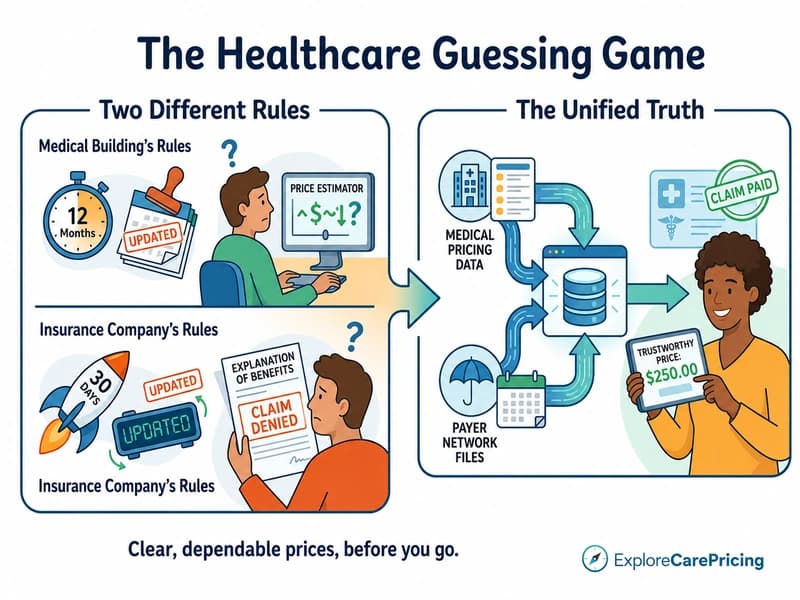
Here is a power move most consumers never think of: compare your EOB's "allowed amount" against publicly available pricing data. Hospitals and insurers must publish their negotiated rates under federal transparency rules, and tools like ExploreCarePricing organize that data for easy lookup. If your EOB's allowed amount for a procedure looks dramatically different from published rates in your area, that is worth a phone call — and next time, you can use the data to choose a lower-cost facility before you go.
Key Takeaways
- An EOB is a report, not a bill — never pay it, and never pay a provider bill without comparing the two first
- The money columns tell one story: billed price → network discount → allowed amount → plan paid → your share
- Your real price is the allowed amount, not the billed amount — the difference simply disappears via the network contract
- Remark codes (CO-45, PR-1, etc.) explain every dollar's movement; the legend is on the document and the phone number works
- Run the five-minute error check on every EOB — wrong services, duplicates, and deductible mistracking are the common catches
- A denial is an invitation to appeal, not a final answer — and external review exists when internal appeals fail
Frequently Asked Questions (FAQ)
Q: Do I need to do anything when an EOB arrives?
A: Two things: run the five-minute error check, and file it (paper or digital). You will want it when the provider's bill arrives and if any dispute ever develops.
Q: Why did I get an EOB but no bill?
A: Bills often lag EOBs by weeks. Also, if your patient responsibility is $0 — say, for preventive care — no bill may ever come. The EOB alone closes the loop.
Q: The bill is higher than the EOB's patient responsibility. Now what?
A: Do not pay the difference yet. Call the provider's billing office with both documents in hand and ask them to reconcile. Common causes: the bill predates the insurance adjustment, a claim is still processing, or a service was never submitted to insurance.
Q: What does "amount not covered" mean on my EOB?
A: It varies: a non-covered service, an out-of-network charge, or an amount above the allowed rate. Check the remark code next to it — and remember that out-of-network providers at in-network facilities may be limited in what they can bill you under the No Surprises Act.
Q: How long should I keep EOBs?
A: A good rule: at least one year for routine care, and for the duration of treatment plus several years for major medical events, disputes, or anything tax-related (such as HSA reimbursements).
Q: I get EOBs for my kids and spouse — why?
A: Family plans generate an EOB for every covered member's claims. Review them too; family members' claims are just as error-prone, and dependents' claims are a common target for identity misuse.
Q: My EOB is online only. Am I missing paper copies?
A: Most insurers have shifted to digital EOBs by default. Check your insurer portal's claims section — every processed claim has one — and adjust delivery preferences if you want paper.
References & Further Reading
- Centers for Medicare & Medicaid Services. From Coverage to Care: Navigate your coverage. https://www.cms.gov/priorities/health-equity/c2c/navigate-your-coverage
- HealthCare.gov. How to appeal an insurance company decision. https://www.healthcare.gov/appeal-insurance-company-decision/
- Centers for Medicare & Medicaid Services. No Surprises Act consumer protections. https://www.cms.gov/nosurprises


Important Disclaimer
This article is provided for general educational and informational purposes only and does not constitute medical, financial, legal, or insurance advice. EOB formats, codes, cost-sharing structures, and appeal procedures vary by insurer, plan, and state, and may change over time. For questions about a specific claim or document, contact your insurance company using the phone number printed on your EOB, and consult qualified professionals before making healthcare or financial decisions.
About the Author
The ExploreCarePricing Team researches, analyzes, and organizes healthcare pricing and policy information to make it clear and usable for consumers. Founded by Rachel Wrought, LPN, SHM, MHI — a healthcare leader with over 18 years of experience spanning clinical nursing, healthcare operations, regulatory compliance, and healthcare innovation — ExploreCarePricing is dedicated to helping families understand what healthcare really costs and how their coverage actually works.