
The Goal of Price Transparency
When Congress enacted the Hospital Price Transparency Rule, the goal was straightforward: give patients meaningful price information before they receive care.
Hospitals are now required to publish two different types of pricing information:
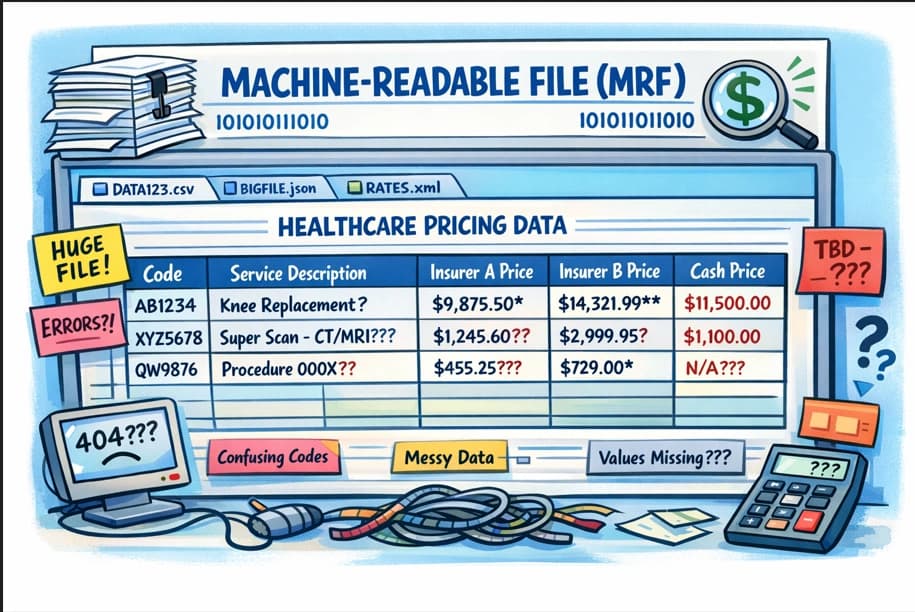
- Machine-Readable Files (MRFs) containing comprehensive pricing data
- Consumer-friendly estimator tools for common "shoppable" healthcare services
On paper, this sounds like a major step toward helping patients compare costs.
But I wanted to answer a more practical question:
Can an average patient actually use these tools to understand what healthcare will cost?
How I Tested Seven Hospital Transparency Tools
To find out, I audited seven health systems across the United States not as a data scientist, but as a consumer. For each organization, I:
- Downloaded the publicly available Machine-Readable File (MRF)
- Verified that the file could be accessed and analyzed
- Used the hospital's public cost estimator or patient-facing pricing tool
- Compared the consumer estimate with the pricing information published in the MRF whenever possible
The results were eye-opening.
Detailed Findings: What Each Health System Does Well—and Where They Fall Short
1. Spanish Peaks Regional Health Center: The Easiest Experience
Spanish Peaks provided the most straightforward consumer experience of every organization evaluated. The pricing information was easy to locate, required very few clicks, and allowed me to obtain pricing without unnecessary barriers or complicated navigation.
Key Observations:
- Minimal navigation required
- Easy to locate pricing resources
- Consumer-focused design
Verdict: Excellent patient usability. This is the gold standard for healthcare price transparency.
2. Lincoln Health: Transparency Hidden Behind Complexity
Lincoln Health technically provides pricing information, but reaching it required navigating multiple pages and menus. After finally obtaining an estimate, I discovered that downloading or printing the estimate required entering personal identifying information.
Key Observations:
- Pricing is available, but the process creates significant friction
- Multiple navigation barriers discourage patient comparison
- Personal information requirement adds burden
Verdict: Available—but unnecessarily difficult to use.
3. Vail Health: Strong Estimate, but Important Details Require Extra Steps
Vail Health's estimator immediately displays an estimated self-pay amount. In my test, the tool estimated $4,824.75 for a bundle of MRI procedures. However, the detailed CPT-level breakdown was only available after selecting the Print Estimate option—not on the website.
Similarly, viewing negotiated insurance pricing required entering insurance information rather than allowing anonymous comparisons.
Key Observations:
- Clear upfront estimate available
- Detailed information requires additional steps
- Insurance comparisons require personal information
Verdict: Strong transparency with moderate friction.
4. Catholic Health: When Consumer Estimates and Published Pricing Differ
Catholic Health's estimator was easy to access. However, when I searched two different MRI procedures—CPT 70551 and CPT 70552—the estimator returned the same quoted price for both.
When those procedures were compared with the hospital's published Machine-Readable File, the listed discounted cash prices differed.
Key Observations:
- Consumer-facing estimate may not distinguish between similar procedures
- Published MRF shows CPT-specific pricing variations
- Possible grouping or estimation methodology differences
Verdict: Consumer estimate did not appear to align with the published MRF pricing for these procedures.
5. Sanford Health: Public Estimator Not Readily Available
Rather than offering an open public estimator, Sanford Health directed me to:
- Log into My Sanford Chart
- Contact the Financial Clearance Center by phone
Key Observations:
- Consumers without an account cannot easily perform anonymous price comparisons
- Phone-based access creates accessibility barriers
Verdict: Limited public accessibility.
6. Texas CHC: Transparency for Computers—Not Consumers
Texas CHC provided downloadable JSON Machine-Readable Files. From a technical standpoint, this satisfies the federal requirement to publish pricing data. However, there was no consumer-friendly estimator to translate that data into understandable pricing.
Key Observations:
- Raw MRF files available for technical use
- No consumer-facing estimator tool provided
- JSON files valuable for developers but not accessible to most patients
Verdict: Technically transparent, but not consumer-friendly.
7. Texas Health Presbyterian Hospital Allen: General Discount vs. Procedure-Specific Pricing
For a self-pay MRI estimate, Texas Health Allen displayed:
- Hospital charges: $4,341
- Self-pay discount: -$1,736
- Estimated patient responsibility: $2,604
The estimate also states that it covers hospital charges only and excludes physician or professional fees. When I compared this estimate with the hospital's Machine-Readable File, I found published discounted cash prices that varied by CPT code and were substantially different from the estimate presented in the consumer tool.
Key Observations:
- Estimator appears to calculate general self-pay estimate from gross charges
- Does not display procedure-specific CPT-level cash pricing
- Methodology differences may explain pricing variations
Verdict: Consumer estimate did not appear to directly reflect the published CPT-level cash pricing.
Summary Comparison Table
| Health System | User Experience | Key Observation |
|---|---|---|
| Spanish Peaks | Excellent | Simple, intuitive, highly accessible |
| Lincoln Health | Fair | Multiple navigation barriers |
| Vail Health | Good | Detailed information available with additional steps |
| Catholic Health | Good | Consumer estimate differed from published CPT pricing |
| Sanford Health | Limited | Requires portal login or phone call |
| Texas CHC | Technical | Raw MRF available but no estimator |
| Texas Health Allen | Good | Estimate appeared to differ from published CPT-level pricing |
What This Means for Patients
After reviewing seven health systems, I came away with one clear conclusion:
The challenge is no longer whether hospitals publish pricing. The challenge is whether consumers can easily understand and use it.
Many hospitals have made meaningful progress. Others continue to present pricing in ways that require additional navigation, account logins, or technical knowledge that most patients do not possess.
Machine-Readable Files remain an important transparency resource, but they were designed primarily for computers—not patients. Consumer estimator tools are intended to bridge that gap, yet my testing showed that the relationship between estimator outputs and published MRF pricing is not always obvious.
That does not necessarily mean the estimate is incorrect. Different methodologies, bundled services, benefit assumptions, or hospital-specific estimation logic may all influence the final estimate. However, greater transparency about how those estimates are produced would help patients better understand and compare their expected costs.
Tips for Patients: How to Maximize Transparency
If you're planning a procedure, consider these actionable steps:
- Ask your provider for the exact CPT or HCPCS code—this helps you find specific pricing rather than bundled estimates
- Save a copy or screenshot of any estimate you receive—this creates documentation for comparison with your final bill
- Ask whether physician, radiology, pathology, or anesthesia fees are included—many estimates cover only facility charges
- If the estimate seems unusually high or generic, ask whether it reflects the hospital's published discounted cash price or another estimation methodology
- Keep your documentation in case your final bill differs significantly from the estimate
What If You Identify a Problem? Where to Report Price Transparency Issues
If you encounter pricing information that appears incomplete, inconsistent, or difficult to access, there are several official channels where you can ask questions or submit concerns. Whether a particular situation constitutes a regulatory violation depends on the specific facts and applicable federal or state requirements.
1. Centers for Medicare & Medicaid Services (CMS) — Hospital Price Transparency
Consider contacting CMS if you believe a hospital may not be meeting the federal Hospital Price Transparency requirements.
Examples where you might file a report:
- Missing or inaccessible Machine-Readable Files (MRFs)
- Consumer price estimator tools that are unavailable or nonfunctional
- Missing required pricing information
- Difficulty locating required transparency resources
Helpful documentation includes: hospital name, website URL, date and time of your visit, screenshots, and a description of what you observed.
2. No Surprises Act Concerns — Good Faith Estimates
If you are uninsured or paying for your own care, federal law may entitle you to receive a Good Faith Estimate before scheduled services. You may wish to review your options if:
- You did not receive a required Good Faith Estimate
- Your final bill is substantially higher than your estimate
- You believe your rights under the No Surprises Act may have been affected
Keep copies of your Good Faith Estimate, final bill, written estimates, emails, and screenshots.
3. State Department of Insurance
Questions involving insurance benefits, negotiated rates, or health plan coverage may also fall under your state's insurance regulator.
- Insurance benefit estimate concerns
- Coverage disputes
- Network status questions
- Health plan billing issues
4. State Attorney General or Consumer Protection Office
If you believe pricing information may be misleading or deceptive, your state's Attorney General or consumer protection office may also accept complaints.
Documentation such as screenshots, estimates, correspondence, and billing statements can help explain the issue.
A Final Thought
Most hospitals are making genuine efforts to comply with increasingly complex transparency requirements. My goal in conducting this review was not to identify "good" or "bad" organizations, but to understand the patient experience and highlight where transparency works well—and where it can still improve.
Price transparency has made significant progress over the past several years. As hospitals continue refining these tools, clear, accurate, and patient-centered pricing information will remain essential to helping consumers make informed healthcare decisions.
Frequently Asked Questions (FAQ)
Q: What is the Hospital Price Transparency Rule?
A: The Hospital Price Transparency Rule is a federal requirement that hospitals publish two types of pricing information: Machine-Readable Files (MRFs) containing comprehensive pricing data and consumer-friendly estimator tools for "shoppable" procedures. The rule, finalized by CMS, applies to hospitals nationwide and aims to improve patient access to pricing information.
Q: Is the pricing on hospital websites guaranteed to be accurate?
A: Hospital websites aim to provide accurate pricing information, but the relationship between estimates and your final bill can be complex. Different methodologies, bundled services, benefit assumptions, and hospital-specific estimation logic all influence estimates. Always confirm pricing with your hospital's financial counselor before service.
Q: What should I do if my final bill is significantly different from the estimate?
A: Contact your hospital's billing or financial counseling department immediately. If the bill is substantially higher than your estimate and you had a Good Faith Estimate, you may have protection under the No Surprises Act. Document all communications and keep copies of your estimate, bill, and correspondence.
Q: Are Machine-Readable Files (MRFs) useful for patients?
A: MRFs are designed primarily for computers and data analysts—not patients. While they contain comprehensive pricing information, they're not user-friendly for most consumers. However, consumer-facing estimator tools extract and translate MRF data into more understandable formats. If you're comfortable with data analysis, MRFs can provide detailed pricing information.
Q: How can I find a hospital's pricing tools or Machine-Readable File?
A: Visit the hospital's main website and look for sections labeled "Price Transparency," "Pricing Tools," "Cost Estimator," or "Patient Pricing." If you can't locate it, call the hospital's financial assistance or patient financial services department. They can direct you to the appropriate resources.
Q: What information should I bring to my appointment to discuss pricing?
A: Bring a copy or screenshot of any estimate you received from the hospital's website, your insurance card, and a list of questions about what's included (facility charges only, or physician fees too?). Ask for the specific CPT or HCPCS codes for your procedure. Having this information ready helps your provider's billing department give you accurate information.
Q: Can I use hospital pricing tools to compare costs between hospitals?
A: Yes, though you'll need to use each hospital's estimator tool separately. Look for the same CPT or HCPCS code across different hospitals to compare pricing. However, be aware that estimates may include different components (facility only vs. facility + physician), so direct comparison can be challenging. Contact hospitals directly if their tools don't provide enough detail for meaningful comparison.
Q: Which of the seven tools was the best overall?
A: Spanish Peaks Regional Health Center delivered the easiest consumer experience in my testing: a findable estimator, plain-language navigation, and procedure-specific prices without requiring insurance details upfront. That said, "best" varied by dimension — some systems had stronger data but weaker usability, and vice versa. The gap between best and worst was the real story.
Q: Are hospital price transparency tools free to use?
A: Yes. Hospital price estimators and the underlying machine-readable files are free — federal rules require hospitals to make them publicly available without charge, and without forcing you to create an account or provide personal information to see standard charges. If a hospital demands extensive personal details before showing any pricing, that is a red flag worth reporting.
Q: Why do different tools show different prices for the same procedure at the same hospital?
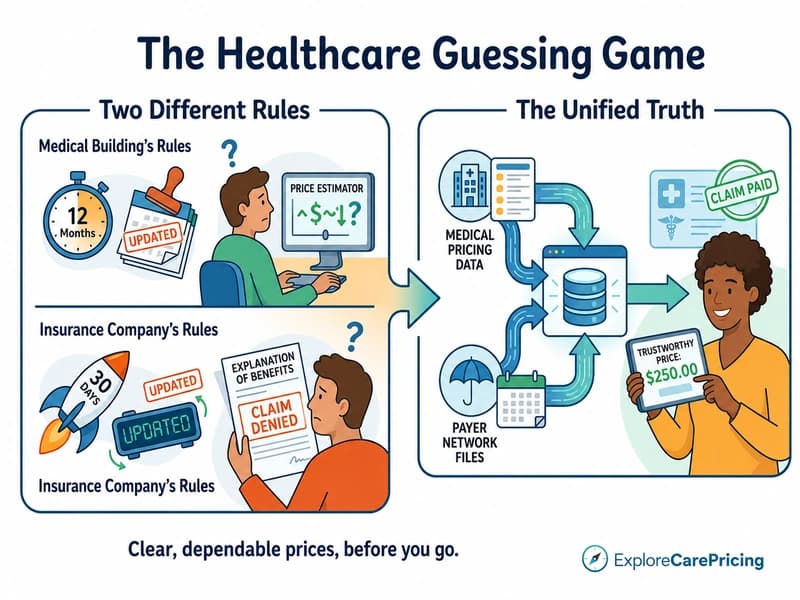
A: Several reasons: estimators and machine-readable files are updated on different schedules; some tools show gross charges while others show negotiated or cash rates; bundled services are grouped differently; and consumer estimates sometimes diverge from the published file data — a discrepancy I found directly in my testing. When numbers disagree, treat them as a range and confirm with the billing office.
Q: Do these estimates include physician fees, anesthesia, and lab work?
A: Often not — and this is one of the biggest gaps I encountered. Many estimators cover only the facility fee, while physicians, anesthesiologists, radiologists, and labs bill separately. Always ask whether an estimate is all-inclusive, and request a Good Faith Estimate for scheduled care, which should account for expected services more completely.
Q: How is ExploreCarePricing different from the hospital tools tested here?
A: Hospital tools show one system's prices at a time, in seven different formats with seven different logins and layouts. ExploreCarePricing aggregates the same published transparency data across facilities and presents it in one consistent, searchable format — so instead of repeating my seven-website experiment yourself, you can compare cash prices and negotiated rates side by side in one place.
References & Further Reading
Federal Regulations & Government Resources:
- Centers for Medicare & Medicaid Services (CMS). Hospital Price Transparency Rule. https://www.cms.gov/priorities/key-initiatives/hospital-price-transparency
- CMS. Good Faith Estimate (GFE) for Uninsured and Self-Pay Patients. https://www.cms.gov/nosurprises
- Federal Register. Hospital Outpatient Prospective Payment System (OPPS) and Ambulatory Surgical Center (ASC) Payment System. Transparency Requirements.
Methodology Note
This review was conducted independently by accessing publicly available hospital price transparency resources during July 2026. Each hospital's publicly available consumer pricing tool and Machine-Readable File were evaluated using identical workflows. Observations are based solely on information available through public-facing websites and downloadable transparency files at the time of testing. Hospital pricing tools, methodologies, and published files may change over time. Findings reflect the state of these tools as of the date of this review.
Important Healthcare and Financial Disclaimer
This article is provided for informational purposes only and should not be construed as medical, financial, or legal advice. ExploreCarePricing is not a substitute for professional medical or financial guidance.
Healthcare and Medical Information:
This article does not constitute medical advice. Healthcare decisions should always involve consultation with qualified healthcare providers who understand your individual medical situation, health history, and treatment options. The pricing information and transparency issues discussed reflect general healthcare practices and do not diagnose, treat, or predict any individual's healthcare costs or outcomes.
Financial Information:
The pricing examples and estimates discussed in this article are based on publicly available hospital data as of July 2026. Actual costs vary based on individual circumstances, insurance coverage, specific procedures, geographic location, and hospital facility. This article is not a guarantee of pricing, an insurance quote, or financial advice. For personal financial or insurance decisions, consult with your insurance provider, financial advisor, or hospital financial counselor.
Accuracy and Updates:
While we strive for accuracy, hospital pricing tools, policies, and regulations change frequently. The information presented reflects conditions at the time of review. Always verify current information directly with healthcare providers, hospitals, and official regulatory agencies before making healthcare decisions.
About the Author
Rachel Wrought, LPN, SHM, MHI is the Founder & CEO of ExploreCarePricing. With over 15 years of healthcare experience spanning clinical nursing, healthcare operations, utilization management, and healthcare innovation, Rachel is dedicated to making healthcare pricing transparent and accessible to everyone. Her Master of Healthcare Innovation from Arizona State University focused on digital health, patient engagement, and improving healthcare transparency through modern tools. ExploreCarePricing exists to empower patients and families to make informed healthcare decisions with clear, upfront pricing information.