The Files That Were Supposed to Change Everything
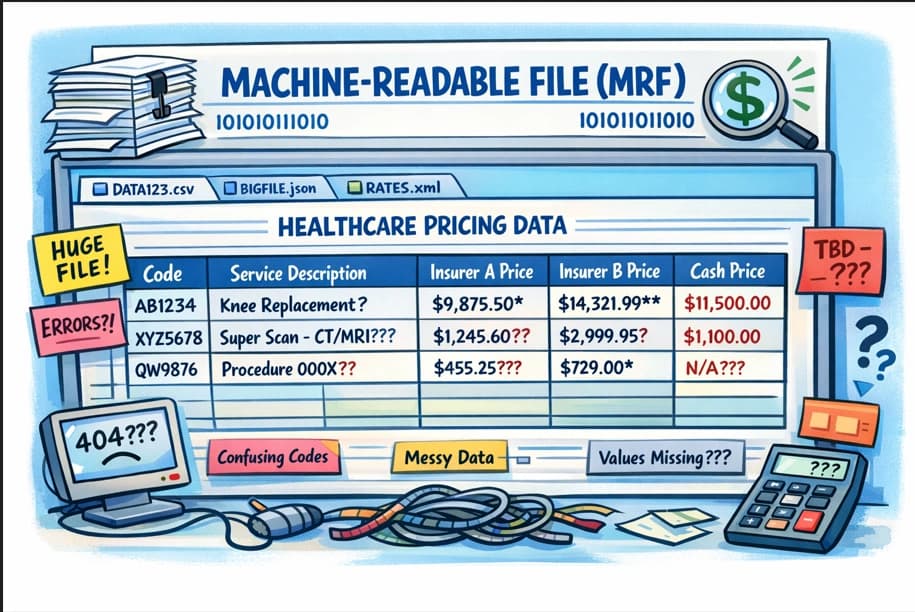
Machine-Readable Files (MRFs) were created to make healthcare prices easier to see. Starting in 2021, the federal government told hospitals — and soon after, insurance companies — that they had to publish their prices in big data files that computers can read. The idea was simple and honestly kind of revolutionary: make prices public so families, employers, and researchers can finally see what care really costs.
For decades, the price of a knee MRI or a C-section was locked inside secret contracts between hospitals and insurers. MRFs cracked those contracts open — every negotiated rate, cash price, and charge, published for anyone to download.
So why can't you just open one of these files and look up your MRI price?
That is where the story gets complicated — and where the gap between "technically public" and "actually usable" becomes the whole ballgame.
What Exactly Is a Machine-Readable File?
A machine-readable file is exactly what it sounds like: a file formatted for computers, not humans. Instead of a friendly webpage with a search box, an MRF is raw structured data — typically in formats called JSON or CSV — listing services, billing codes, and prices.
Two federal rules require them:
- Hospital Price Transparency Rule (January 2021): every hospital must publish a machine-readable file listing its standard charges — including gross charges, cash prices, and the rates it negotiated with each insurance plan
- Transparency in Coverage Rule (July 2022): health insurers must publish their own MRFs showing negotiated in-network rates and historical out-of-network payments for essentially every provider they work with
Think of it like this: the hospital's file says "here is what we charge everyone," and the insurer's file says "here is what we pay everywhere." Between the two, the entire hidden pricing system of American healthcare is now, on paper, public.
The First Surprise: These Files Are Enormous
Here is where good intentions meet messy reality. MRFs are not spreadsheets you scroll through over coffee. They are some of the largest routinely published data files in any industry:
- A single hospital's file can run to millions of rows — one row for every service, for every insurance plan, for every rate type
- Insurer files are even bigger: a large national insurer's monthly MRF release can total multiple terabytes — more data than most laptops can even open
- Files are refreshed monthly or annually, and the structure can quietly change between releases
To put that in perspective: if you printed one large insurer's monthly file, you would need a stack of paper taller than a skyscraper. No patient — and honestly, no billing office — is reading that by hand. The data is public, but it is public the way a library with no card catalog, no shelves, and books written in five languages is "open to everyone."
What Happens When a Regular Person Actually Tries to Open One
Let's be honest about what this looks like in real life. Imagine you are reasonably tech-comfortable — spreadsheets at work, can find anything on Google — and you decide to look up your hospital's MRI price yourself. Here is how that afternoon goes.
Step 1: Your Device Cannot Even Open the File
You find the hospital's transparency page and click download. A hospital file might be a few hundred megabytes — annoying, but manageable. Your insurance company's file is another story: a single insurer file can run tens or hundreds of gigabytes, and a full monthly release can reach terabytes — more than most laptops can store, let alone open. Excel, the tool most people would reach for, caps out at roughly one million rows; many MRFs blow past that before they are halfway loaded. Your phone? The download alone could consume your entire data plan.
Step 2: Even If It Opens, It Does Not Look Like Prices
Suppose a smaller hospital file actually opens. What you see is not a price list. JSON looks like a wall of code — thousands of curly braces and brackets, with data nested inside data like Russian dolls. No search box. No column headers saying "MRI" and "Price." A single price might sit five layers deep in a structure that only makes sense if you already know how the file was built.
Step 3: The Words Do Not Mean Anything to You
Even the entries you can find are written in billing language, not human language. Instead of "MRI of the brain," you see "70551" alongside abbreviations like "DRG," "APC," or "per diem." Knowing whether that number is the price you would actually pay requires understanding billing codes, plan naming, and rate types — knowledge even many healthcare workers do not fully have.
The Bottom Line
The average person is not failing here for lack of effort or intelligence — the files simply were not built for them. Reading an MRF without specialized tools is like being handed a car's raw blueprints and supplier invoices and told, "The price is in there somewhere." Technically true; practically useless. That is the transparency paradox: the data is public, but the format keeps it out of reach of the very people it was meant to serve.
The Bigger Problem: Nobody Speaks the Same Language
And size and format are only half the story. The deeper problem is that there is no true standard for how this data gets organized — and every hospital and insurer does it a little differently.
Different Formats, Different Structures
CMS published guidelines and even a template, but files arrive in wildly different shapes. Some hospitals publish clean JSON; others post sprawling CSVs with custom column names; some bury prices in nested structures that take serious programming skill to unpack. A few technically "comply" with files so poorly structured that extracting one usable price takes real detective work.
Different Names for the Same Thing
One hospital calls it "MRI brain w/o contrast." Another calls it "MR IMAGING, BRAIN, WITHOUT DYE." A third lists only the billing code: 70551. They are all the same scan. Multiply that inconsistency across tens of thousands of services and thousands of facilities, and matching apples to apples becomes one of the hardest parts of the entire transparency project.
Different Ways of Expressing a "Price"
Even the prices themselves come in different flavors. Some rates are flat dollar amounts. Others are percentages of billed charges, per-day rates, bundled episode rates, or formulas tied to Medicare. Two hospitals can both "publish their negotiated rate" for the same procedure in ways that are mathematically impossible to compare without translation.
Insurers and Hospitals Do Not Match Each Other
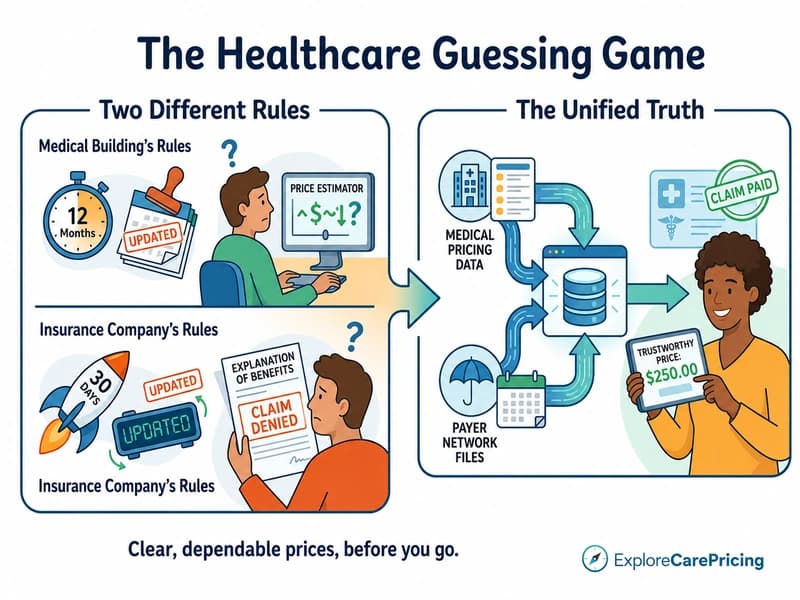
Here is the kicker: hospital files and insurer files describe the same contracts — but often disagree. Different effective dates, code groupings, and plan naming mean researchers regularly find mismatches for identical services at identical facilities. When the two "official" sources disagree, which is right? Often there is no easy answer.
Why MRFs Still Matter — A Lot
It would be easy to conclude the whole thing is a failure. That would be wrong. Even messy, MRFs represent one of the biggest steps toward healthcare transparency in American history:
- Prices that were contractually secret for decades are now public record — that alone changes negotiating dynamics
- Employers can finally audit whether their health plans negotiated good rates
- Researchers can map price variation across markets — and their findings are already shaping policy
- Journalists have exposed eye-popping price differences (the same procedure varying 5x or 10x within one city) using MRF data
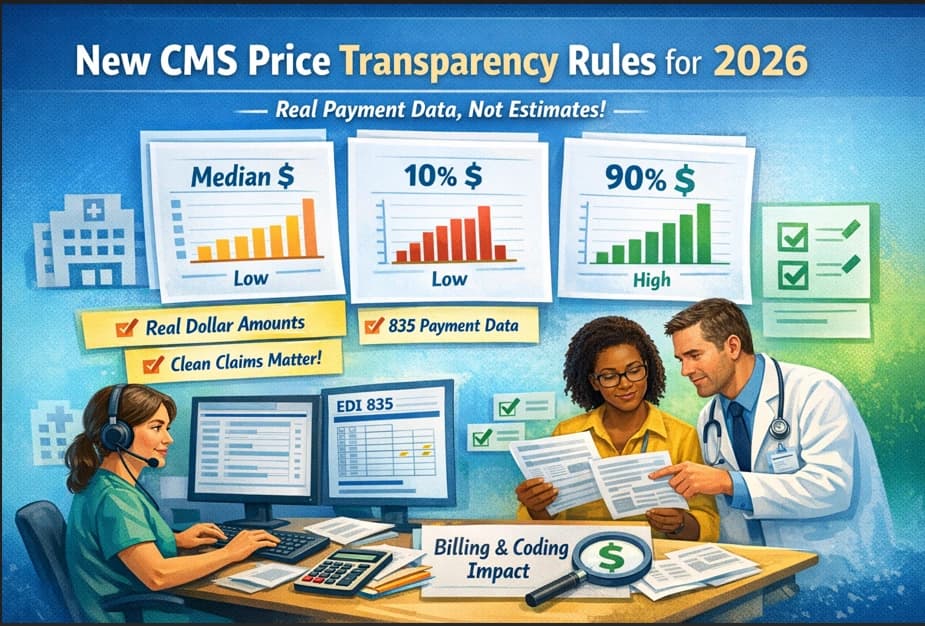
- The 2026 strengthening of the transparency rule requires actual paid amounts — median, 10th, and 90th percentiles — making the data more honest with each cycle
The raw material for a transparent healthcare market now exists. What is missing is the translation layer.
Turning Raw Files Into Real Answers: Where ExploreCarePricing Comes In
This translation problem is exactly why ExploreCarePricing exists. Our work is industrial-scale cleanup of the mess described above:
- We download and process the terabyte-scale insurer releases and million-row hospital files that would crash a personal laptop
- We standardize inconsistent service names and map them to common billing codes, so "MRI brain w/o contrast" and "MR IMAGING, BRAIN, WITHOUT DYE" become the same searchable service
- We normalize different price expressions into comparable dollar figures
- We organize everything so a family can search a procedure and see cash and negotiated prices side by side — in plain language, with a search box, on any device
One important note on trust:we do not create, alter, or predict prices. Every figure traces back to a hospital's or insurer's own published file. Our job is translation, not invention — taking data that is technically public and making it practically useful.
What You Can Do With This (Even Without Opening a Single File)
- Before scheduled care, search your procedure in a transparency tool like ExploreCarePricing to see typical cash and negotiated prices in your area.
- Ask your hospital for its published cash price — under federal rules, it must exist. If a quoted price is far above the published figure, ask why.
- Compare two or three nearby facilities; MRF data shows the same service routinely varies by hundreds or thousands of dollars within a short drive.
- Use published prices as leverage when reviewing or negotiating a bill — "your own transparency file lists this at $X" is a powerful sentence.
- If you cannot find a hospital's file at all, that is a compliance red flag you can report to CMS.
Key Takeaways
- MRFs are federally required data files in which hospitals (since 2021) and insurers (since 2022) must publish their real prices
- The files are enormous — millions of rows, sometimes terabytes — and are built for computers, not people
- Ordinary devices and software cannot handle them: insurer files exceed laptop storage, Excel's row limits, and mobile data plans, and JSON reads like a wall of code with no search box
- Even readable entries use billing codes and rate jargon (70551, DRG, per diem) rather than plain language
- The biggest structural obstacle is non-standardization: different formats, different service names, different price expressions across every hospital and insurer
- Hospital files and insurer files often disagree about the same contract, complicating even expert analysis
- Despite the mess, MRFs made decades-secret prices public — a genuine turning point for healthcare transparency
- Tools like ExploreCarePricing exist to translate this raw data into clear, comparable, plain-language pricing for real people
Frequently Asked Questions (FAQ)
Q: Can I open and read an MRF myself?
A: Technically yes — they are public downloads. Practically, hospital files often exceed Excel limits, insurer files can exceed your laptop storage, and JSON requires programming tools to parse. That is the gap consumer tools close.
Q: Why are insurance company MRFs so much bigger than hospital files?
A: A hospital publishes prices for one facility. An insurer must publish rates for essentially every provider in every network nationwide, for every plan. That multiplication produces files measured in gigabytes and terabytes.
Q: Why do hospitals publish such messy files? Is it deliberate?
A: It varies. Clean files are genuinely hard for hospitals with legacy billing systems, and early rules left room for interpretation — though compliance reviews have found files satisfying the letter of the rule more than its spirit. Requirements tighten with each update, including the 2026 changes.
Q: Are the prices in MRFs the prices I will actually pay?
A: Not exactly. They show negotiated rates and cash prices, but your personal cost depends on your deductible, coinsurance, and network status. Think of MRF data as the honest starting point — then verify your out-of-pocket amount with your insurer.
Q: Which is more reliable — the hospital's file or the insurer's file?
A: Neither is automatically right, and they sometimes disagree for the same service. Good transparency tools cross-reference both. When numbers conflict, treat them as a range and confirm with the provider before scheduling.
Q: What happens if a hospital simply does not publish an MRF?
A: CMS can issue warnings, corrective action plans, and civil monetary penalties that scale with hospital size — and enforcement activity has increased every year since 2021. Consumers can report missing or inadequate files directly to CMS.
Q: Where does ExploreCarePricing fit into all this?
A: We process, standardize, and organize published MRF data so consumers can search and compare prices in plain language. Every price traces back to a hospital's or insurer's own published file — we translate the data; we never invent it.
References & Further Reading
- Centers for Medicare & Medicaid Services. Hospital Price Transparency. https://www.cms.gov/priorities/key-initiatives/hospital-price-transparency
- Centers for Medicare & Medicaid Services. Hospital price transparency enforcement updates and penalties. https://www.cms.gov/


Important Disclaimer
This article is provided for general educational and informational purposes only and does not constitute medical, financial, legal, or insurance advice. Published pricing data reflects information made available by hospitals and insurers under federal transparency rules and may contain errors, omissions, or outdated figures. Actual costs depend on your insurance plan, network status, and individual circumstances. Always verify prices directly with your provider and insurance company before making healthcare or financial decisions.
About the Authors
Rachel Wrought, LPN, SHM, MHI, Founder & CEO of ExploreCarePricing, brings over 18 years of healthcare experience spanning clinical nursing, healthcare operations, regulatory compliance, healthcare technology, and healthcare innovation. With a Master of Healthcare Innovation from Arizona State University, Rachel leads the work of turning raw healthcare pricing data into clear, usable information for families. This article was developed with the ExploreCarePricing Team, whose engineers and analysts process and standardize the machine-readable files described here — transforming raw pricing data into clear, comparable information for consumers.
Data sourced from public transparency datasets — prices are estimates and not used to diagnose or guarantee treatment.